
.png)


Nail Art Ideas for Every Season in Chicago: A Year-Round Guide
Anyone searching for nail art Chicago inspiration has one big advantage: this city refuses to look the same for very long. A gray February morning, a soft April afternoon, July by the lake, October when every tree seems to turn at once — each one suggests a completely different manicure.
And that is the fun of seasonal nails. You do not need tiny pumpkins in October or snowflakes in December to make the idea work.
Sometimes the season shows up through color. Sometimes texture. A darker tip, a flash of chrome, one hand-painted flower, a cloudy milky finish. Small choices can change the entire mood.
This guide moves through nail art ideas Chicago clients can wear all year, starting light and fresh in spring, getting brighter through summer, deeper in fall, then cleaner and moodier once winter settles in.
Why Chicago's seasons are perfect nail art inspiration
Chicago gives you material.
Spring feels tentative at first. One sunny afternoon arrives and suddenly everyone is outside, even though half the city is still carrying a jacket just in case. Lincoln Park starts turning green again. Pale pinks, soft blues, tiny florals and translucent finishes make sense.
Summer is another personality entirely. Lake Michigan looks almost unreal on a clear day. Rooftops fill up, clothes get brighter, metallic details finally get the sunlight they deserve.
Then September changes the palette.
Brown leather, dark denim, burgundy, forest green, amber, black. By winter, there is even more room to play with contrast: glossy dark nails against a wool coat, silver details under restaurant lighting, or barely-there pearl over a milky base.
The best seasonal nail designs Chicago has to offer do not have to literally illustrate the weather. They can simply borrow from it.
That usually looks better anyway.
Spring nail art in Chicago
Chicago spring is not exactly predictable.
Some mornings still feel like winter. Then one afternoon reaches the 60s and every patio table in the neighborhood is suddenly occupied.
That in-between feeling works beautifully for nail art because spring does not require loud color. Soft shades feel right, but so do sheer bases, delicate drawings and details that only become noticeable when you look closely.
Think pale lilac beside warm ivory. Petal pink with almost-transparent green. Powder blue fading gently into cream.
Nothing needs to match perfectly.
Floral accents: modern and minimal
Forget a full set covered in tiny painted bouquets.
Modern floral nails are much lighter than that.
Picture short almond nails in a translucent nude. Four are left almost bare, glossy and clean. On the ring finger, there is one tiny white flower with an imperfect yellow center. The petals are thin rather than cartoonishly rounded.
That is enough.
Another version could use two miniature blossoms sitting near the cuticle, leaving most of the nail empty. On a longer shape, a single curved stem can travel diagonally across the nail, ending in two tiny petals.
The flower almost becomes a line drawing.
Color changes the mood quickly. White petals on nude feel understated. Pale blue feels cooler. Red micro-flowers create a slightly retro look without turning the manicure into full vintage nail art.
If you want something more noticeable, alternate plain pastel nails with one or two hand-painted floral accents rather than decorating all ten fingers.
The blank space is part of the design.
Pastel gradients and aura nails
Pastels can go wrong when every nail is painted a different sugary shade with no connection between them.
A gradient fixes that.
One nail might begin with butter yellow, followed by peach, blush pink, lilac and finally a hazy blue across the hand. The colors move gradually instead of looking randomly selected.
Aura nails take the same idea and blur it.
Imagine a sheer pink base with pale lavender concentrated at the center, fading outward until it almost disappears. Or milky white with a diffused mint-green glow.
There are no hard edges. That softness is what makes the style work.
For spring, lighter combinations tend to feel especially fresh: blush and peach, blue and lilac, cream and pale yellow. The finish can stay glossy, although a soft pearlescent layer on top makes the colors look even more delicate.
These kinds of nail designs Chicago clients can wear well into early summer too. They do not scream “spring manicure.”
They just look good in spring.
Botanical line art
Botanical nails are for anyone who likes the idea of florals but wants something cleaner.
Instead of painted flowers, the design uses thin branches, individual leaves and curved stems. Usually very little paint is involved.
A warm nude base with one black branch painted along the side of the nail looks almost graphic. Fine olive-green leaves over sheer beige feel softer. White botanical lines can be even more subtle because they disappear slightly against a pale base.
The positioning matters.
A branch does not need to sit neatly in the middle. In fact, it often looks better entering from one corner, crossing part of the nail, then ending before reaching the opposite side.
That slight asymmetry keeps minimalist nail art from becoming too precious.
Summer nail art in Chicago
Summer nails have more room to misbehave.
Bright light changes how polish looks, especially anything reflective. A chrome manicure that seems sleek indoors suddenly catches every bit of sunlight outside. Saturated blues feel sharper. Orange makes more sense. Even neon can work if the rest of the design is restrained.
Chicago summer gives you plenty to borrow from: blue water, rooftop sunsets, bright umbrellas along the Lakefront, festival weekends and dinners that somehow stretch until late.
This is where nail art trends Chicago often become more graphic.
A little bolder. Less polite.
Chrome and metallic summer looks
Chrome does not have to mean ten silver mirror nails.
Although, yes, that works.
For something softer, start with a pale pink or nude manicure and add chrome only to the tips. The effect looks clean from a distance, then suddenly flashes when your hand moves.
Gold chrome over a warm beige base feels especially good with summer skin tones. Silver has a cooler, almost liquid look. Rose gold sits somewhere in between and pairs easily with pinks, creams and translucent bases.
Chrome can also appear in pieces.
A thin metallic curve near the cuticle.
One chrome nail beside four glossy neutral ones.
A silver swirl over transparent pink.
Even tiny metallic dots can catch enough light to change the whole manicure.
If full mirror chrome feels too futuristic, ask for a glazed effect instead. The shine is softer and slightly cloudy, as though the metallic layer has been pressed underneath the surface rather than sitting on top.
Color-blocking: bold and graphic
Color-blocked nails look simple until the colors are wrong.
Then they look very wrong.
The strongest combinations usually have clear contrast. Cobalt blue beside bright orange. Cherry red with pale pink. Lime against soft lilac. Black paired with cream.
Instead of painting one entire nail one color, the surface is divided.
One side blue, one side pink.
A diagonal block across the corner.
A rounded section of red sitting against a nude base.
The line can be razor sharp or slightly curved depending on the effect you want.
For a more wearable version, use two tones from the same family. Pale pink with deep berry feels polished rather than loud. Light blue beside navy gives the same graphic effect without introducing another color.
Color-blocking is also useful when you love a bright shade but do not necessarily want ten solid neon nails staring back at you for the next few weeks.
A little restraint helps.
Negative space designs
Negative space means part of your natural nail remains visible as part of the design.
It sounds simple. Visually, it can be surprisingly strong.
On long almond nails, imagine a clear diagonal opening dividing two glossy black sections. Another design might leave a curved transparent stripe through the middle of a cobalt nail.
There are lighter versions too.
A nude base with thin colored arcs.
Two small blocks of coral at opposite corners.
French tips with a tiny gap between the color and the natural nail.
Negative space works especially well on longer nails because there is more surface to create the contrast, though short nails can handle simpler versions beautifully.
And because part of the nail stays bare or sheer, brighter summer colors become easier to wear.
Fall nail art in Chicago
Fall changes the city fast.
The trees around Lincoln Park turn gold and copper, café tables get replaced by coats and scarves, and suddenly the colors that felt too heavy in August look exactly right.
This may be the easiest season for nail art.
Burgundy. Espresso brown. Olive. Rust. Caramel. Deep red. Smoky gray.
Almost everything plays nicely together.
For seasonal nail designs Chicago clients save for autumn appointments, depth often does more work than decoration. A brown manicure with one unusual finish can feel more seasonal than ten tiny painted leaves.
Abstract earthy designs
Abstract fall nails borrow the colors of the season without drawing anything literal.
Start with a creamy nude base.
Add a soft terracotta curve on one corner, a chocolate-brown shape on another, perhaps a thin black line crossing through one nail. Each finger can be slightly different while still using the same small palette.
The shapes should not look perfectly measured.
That is part of the appeal.
One nail might have a large burgundy section occupying half the surface. Another gets only a tiny caramel oval near the edge. A third stays nearly bare except for one curved line.
Matte topcoat can make earthy colors look softer and flatter, almost ceramic. Gloss gives the same palette more richness.
Both work.
For something darker, swap the beige base for smoky taupe and use wine red, espresso and muted olive over it.
Dark French with colored tips
A French manicure changes completely when the white tip disappears.
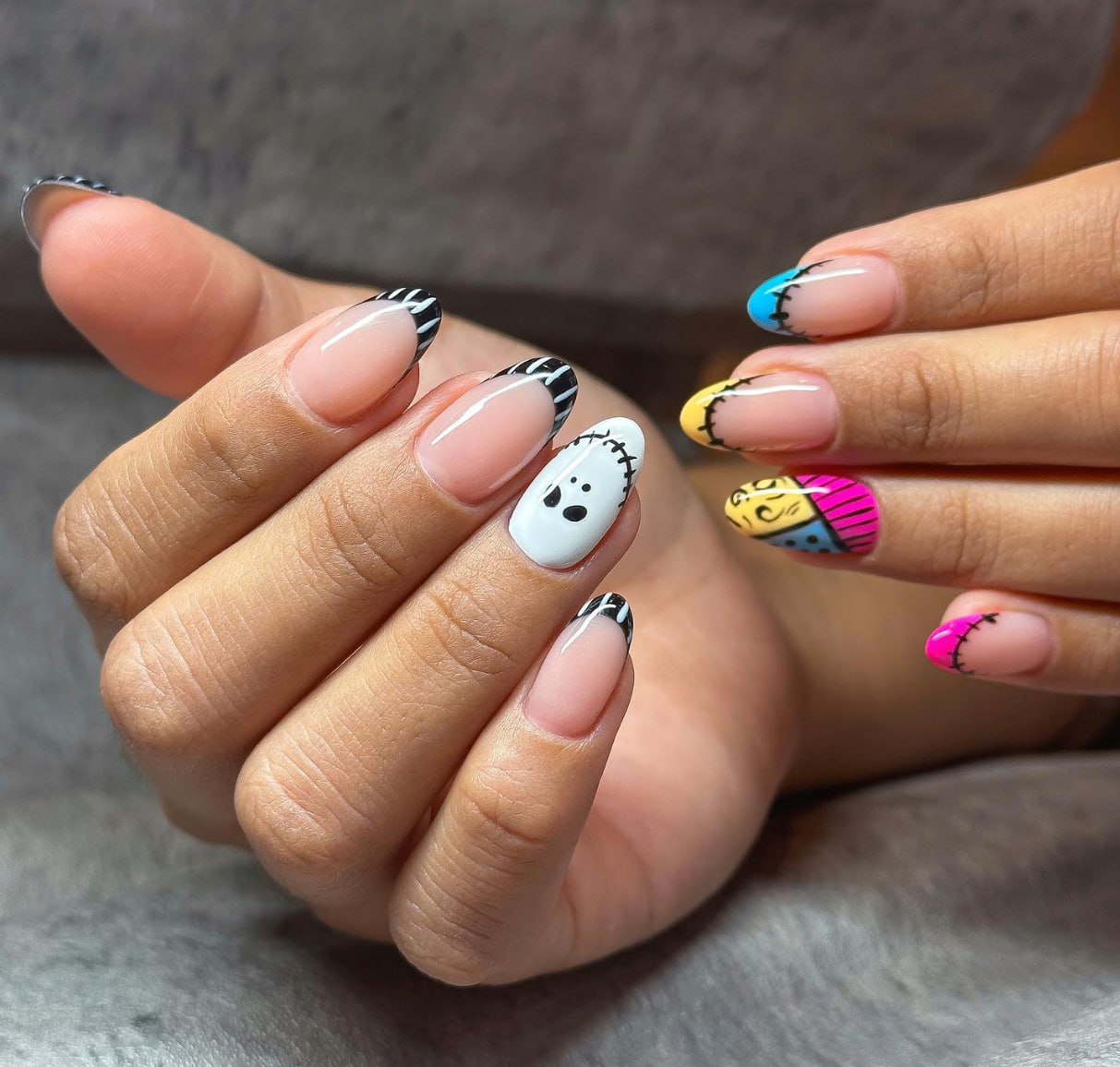
Black tips feel sharp and clean. Deep burgundy is softer, especially over a pink-nude base. Forest green can look almost neutral in dim light, then clearly green when you step outside.
The width matters here too.
A micro-French line is delicate and works beautifully on shorter nails. A deeper curved tip gives long almond or oval nails more drama.
You can also mix colors across the hand.
Burgundy on one finger, dark brown on the next, then forest green, black and muted rust. Because the base stays consistent, the result still feels intentional.
Another variation uses the same dark color on every tip and adds one tiny detail somewhere else — perhaps a gold dot near the cuticle or one miniature star.
Small, but not boring.
Tortoiseshell and marble effects
Tortoiseshell nails look particularly good once the temperature drops.
The design layers translucent amber, caramel and dark brown so the colors seem suspended inside the nail rather than painted flat on top.
No two nails should look identical.
Some can be lighter and honey-colored. Others can have darker patches concentrated near the edges. When the finish is very glossy, the depth becomes even more noticeable.
Tortoiseshell also works beautifully as an accent. One patterned nail beside espresso brown or burgundy is usually enough.
Marble gives a cooler alternative.
Instead of traditional white marble, fall versions can use deep green with fine cream veins, smoky brown with black, or burgundy broken up by pale irregular lines.
These effects imitate natural material, but they should not look printed.
Slight variation makes them convincing.
Winter nail art in Chicago
Chicago winter has a reputation, and deservedly so.
Outside, everything gets harder and colder. Inside, though, the city leans in the opposite direction: warm restaurants, candlelight, decorated windows, holiday dinners, dark coats, polished boots.
That contrast gives winter nails their character.
You can go extremely dark or almost completely pale.
Both feel right.
Festive accents without kitsch
Holiday nail art does not need ten different Christmas references across ten fingers.
One is plenty.
Imagine deep wine-red nails with a tiny gold star painted on the ring finger. Or black cherry polish with one narrow line of glitter running vertically down a single nail.
A sheer nude manicure can get even quieter: one miniature silver star, a tiny crystal near the cuticle, or a few irregular gold dots scattered across one finger.
Glitter works best when it has somewhere to stop.
Instead of covering the full nail, concentrate it near the tip and let it fade downward. Or use a glitter French tip against a translucent base.
You still get the holiday light-catching effect, just without turning every nail into an ornament.
Swarovski stones can work the same way.
One stone placed precisely near the cuticle often looks more expensive than a whole nail covered in crystals.
Minimalist winter elegance
Dark winter manicures need very little assistance.
Short glossy black nails are already a look. So are oxblood, espresso, charcoal, midnight blue and deep forest green.
The finish becomes the detail.
High shine makes dark colors look almost wet. Matte topcoat takes away the reflection and makes them much flatter and moodier. A subtle cat-eye effect adds a narrow streak of light that shifts as the hand moves.
At the other end of the palette are glazed donut nails.
These usually begin with a milky white, soft pink or semi-sheer neutral base. A pearly chrome layer sits over the top, giving the nail a translucent glow rather than obvious glitter.
In winter, that milky finish looks especially good against black coats, gray knits and darker clothes.
You can keep all ten nails glazed or break the set with a tiny chrome French tip, a single crystal, or one hand-painted silver detail.
The effect is very clean.
Almost too clean, which is probably why it works.
Nail art at Flamant: what we actually offer
A reference photo is useful, but the final design still depends on nail length, shape, base color and how much detail you actually want to wear.
Flamant offers several ways to build custom nail art Chicago clients can personalize rather than choosing from one fixed style.
Current nail art options include:
- French — $20
- Reverse French — $25
- Chrome — $20
- Cat-Eye — $20
- Stamping — $3 per nail
- Hand-Painted Design — $3 per nail
- Airbrush Ombré — $30
- Sticker Design — $3 per nail
- Swarovski Stones — $1 per stone
You can see the complete service menu on the Flamant services page.
Some designs are easy to combine, too. A French manicure can get chrome tips. Airbrush ombré can become the base for a small hand-painted detail. Cat-eye polish may be enough on its own, or it can sit beside a few simpler solid nails.
Bring the photo you saved.
Then adapt it.
A design that looks beautiful on extra-long coffin nails might need a different layout on short almond nails, and sometimes the modified version ends up looking better anyway.
Frequently Asked Questions
What nail art is popular in Chicago right now?
Chrome, cat-eye finishes, delicate French variations, aura effects and minimalist hand-painted designs are all easy to adapt to different seasons. Rather than following one nail art trends Chicago look exactly, many clients combine a current technique with colors that fit their personal style.
What are the best nail colors for each season in Chicago?
Spring works naturally with soft pink, lilac, pale blue and fresh green. Summer can handle brighter colors and metallics. Burgundy, brown and olive fit fall beautifully, while winter tends to favor dark polished shades, silver, pearl and milky neutrals.
Can I bring a Pinterest or Instagram nail art photo to my appointment?
Yes. Reference images are useful for showing the colors, placement and overall feel you like. The design may be adjusted to work with your nail length, shape or chosen service rather than copied detail for detail.
How much does custom nail art cost at Flamant?
Pricing depends on the technique. Hand-painted designs, stamping and stickers are $3 per nail, while French, chrome, cat-eye and airbrush ombré have set service prices. Swarovski stones are priced individually at $1 per stone.