
.png)


Airbrush Ombré Nails: What They Are and How They're Done at Flamant
If you have been looking at ombre nails Chicago inspiration lately, you have probably seen the effect even if you did not know exactly how it was created. One color seems to melt into another. There is no obvious dividing line, no stripe where pink suddenly becomes white or blue turns into turquoise. Just a soft transition across the nail.
Sometimes that gradient is subtle enough that you notice it only when the hand moves.
Sometimes it is the whole point.
Airbrushing is one way nail artists create that particularly smooth finish. Instead of blending thick layers of polish directly with a brush, the technician sprays fine layers of color over the nail, gradually building the gradient until the transition looks almost weightless.
At Flamant, airbrush ombré can be added to a manicure when you want something more interesting than one solid shade but still clean enough to wear every day.
And there are a lot more options than the classic white fade.
What are airbrush ombré nails?
Ombré simply means one color gradually transitions into another.
On nails, that transition can run vertically, horizontally, through the center or even outward from one concentrated area. You might have soft pink near the cuticle slowly fading into milky white at the tip. Another manicure could move from deep navy into a bright pool-blue shade.
There should not be a hard border between them.
That is the important part.
With airbrush ombre nails, pigment is applied in a very fine mist. Because the color arrives in such light layers, a nail artist can control where it becomes stronger and where it fades away.
The result often has a slightly hazy quality. Not blurry exactly, just very soft.
Picture a nude almond nail with white concentrated at the tip. Instead of the clear curved line of a French manicure, that white starts dense at the edge, then becomes lighter as it travels toward the center. Eventually, it disappears into the base color.
That is probably the most familiar version.
But ombré does not have to look delicate.
Black can fade into burgundy. Hot pink can dissolve into orange. Lavender can move into icy blue. A bright center can sit inside a darker border, giving the nail an almost glowing appearance.
The technique stays the same even when the mood changes completely.
That is why gradient nails Chicago clients bring in can range from bridal neutrals to something much louder.
How the airbrush technique works
An airbrush manicure sounds more technical than it actually needs to.
There is equipment involved, yes, but from the client's side the idea is pretty simple.
The nail artist uses a small airbrush tool connected to a compressor. The compressor pushes air through the tool, which releases special nail color in a very fine spray.
Think mist rather than brushstroke.
The manicure itself is prepared first. Nail shape, cuticle work and the main base coating are handled before the gradient design begins.
Then the color starts going on gradually.
The gradient is built in layers
Airbrush color is not usually applied as one heavy blast.
A technician works in thin passes.
The first layer might look almost too faint. Another pass makes one part of the nail stronger. Then another adds more saturation exactly where it is needed.
That slow buildup is what creates the smooth transition.
For a white-to-nude ombré, for example, the technician may concentrate white near the free edge of the nail while allowing less and less pigment to reach the center. The nude base underneath remains visible, so the two shades seem to merge.
A more colorful design follows the same principle.
If you choose blue and turquoise, one shade can be applied first and the second introduced gradually until the middle area becomes a mix of both.
There is a little judgment involved here.
Actually, quite a lot.
A gradient can technically be smooth and still look wrong if one color occupies too much of the nail or if the transition begins in an awkward place. A good ombré has balance. You should still be able to recognize both shades without seeing the exact point where one ends.
How much longer does it take?
At Flamant, adding an airbrush ombré generally takes around 30 additional minutes beyond the main manicure service.
That extra time gives the technician room to build the color slowly, check the gradient from different angles and make the nails look consistent across both hands.
Consistency matters more than people think.
One thumb that fades halfway down while the other stops near the tip is surprisingly noticeable once the manicure is finished.
The final design is sealed as part of the manicure, leaving the surface smooth and glossy rather than textured from the sprayed color.
So although the process uses different equipment, you are not walking out with anything sitting roughly on top of the nail.
It feels like a regular finished manicure.
It just looks very different.
Airbrush vs hand-painted ombré: what's the difference?
This is where terminology gets messy.
People often call any blended nail design "airbrush," even when no airbrush was used at all.
Ombré can also be created by hand.
A nail technician may blend gel colors using brushes, sponges or other tools, working the shades together manually before curing or sealing the design. That gives the artist more direct control over individual areas.
The overall idea is the same.
The finish is not always identical.
An airbrush manicure Chicago client chooses specifically for a smooth gradient tends to have a very fine, even fade. Because pigment is being sprayed rather than physically brushed back and forth, visible marks are less likely to become part of the design.
Hand-painted work can feel more intentional and artistic.
You may see stronger boundaries, unusual shapes or blending that changes from nail to nail. Sometimes that slight irregularity is exactly what makes the design interesting.
Both techniques are available at Flamant.
Which one works better depends on the reference you bring.
When airbrush gives a better result
Airbrush is particularly good when the gradient itself is the design.
Classic baby-boomer nails are a perfect example: pink or nude at the base softly disappearing into white. The attraction comes from how cleanly those two colors melt together.
There should be no obvious brush lines.
Airbrush also works beautifully for aura-style effects.
Imagine pale pink across the full nail with a cloud of deeper raspberry in the center. The stronger color has no defined edge. It simply gets lighter and lighter until it meets the base.
The same can be done with blue, violet, orange or even black.
An airbrush is useful when you want:
- A very smooth white-to-nude fade
- Soft transitions between two related colors
- Aura or diffused-center designs
- A consistent gradient across all ten nails
- A clean base for additional nail art
That last one opens up more possibilities.
A simple airbrush gradient can be finished as-is, or used underneath chrome, line work, crystals or another small design.
You do not have to pile things on, though.
Often the fade is enough.
When hand-painted ombré works better
Hand-painted blending makes more sense when the design is not supposed to look perfectly uniform.
Maybe one nail moves from burgundy into black diagonally, while the next has a curved section of burgundy crossing a nude background. Another might combine blended color with painted flames, abstract lines or irregular shapes.
That is less about achieving a flawless misted transition.
It is more about composition.
Hand painting also makes it easier to change the gradient placement from nail to nail. The fade can be stronger on one side, interrupted by another color, or incorporated into a completely different graphic design.
Some references that look like "ombré nails" are actually complicated hand-painted artwork with several blended areas.
In those cases, forcing everything through an airbrush would not necessarily make the result better.
The tool should follow the design.
Not the other way around.
Which color combinations work best for ombré
This is usually the enjoyable part.
And also where people can spend twenty minutes staring at color samples because suddenly every combination seems possible.
Technically, almost any two shades can be blended.
Visually, some pairings are easier.
White and nude: the classic
White fading into nude or pale pink remains one of the safest choices for ombre gel nails Chicago appointments.
It is soft, polished and noticeable without depending on a bright color.
On almond nails, the transition can make the shape look especially elongated because there is no hard line breaking up the surface.
Short nails can wear it too.
The fade simply needs to be adjusted so both colors still have enough room to show.
This combination works year-round and does not clash with much of anything, which explains why people keep coming back to it.
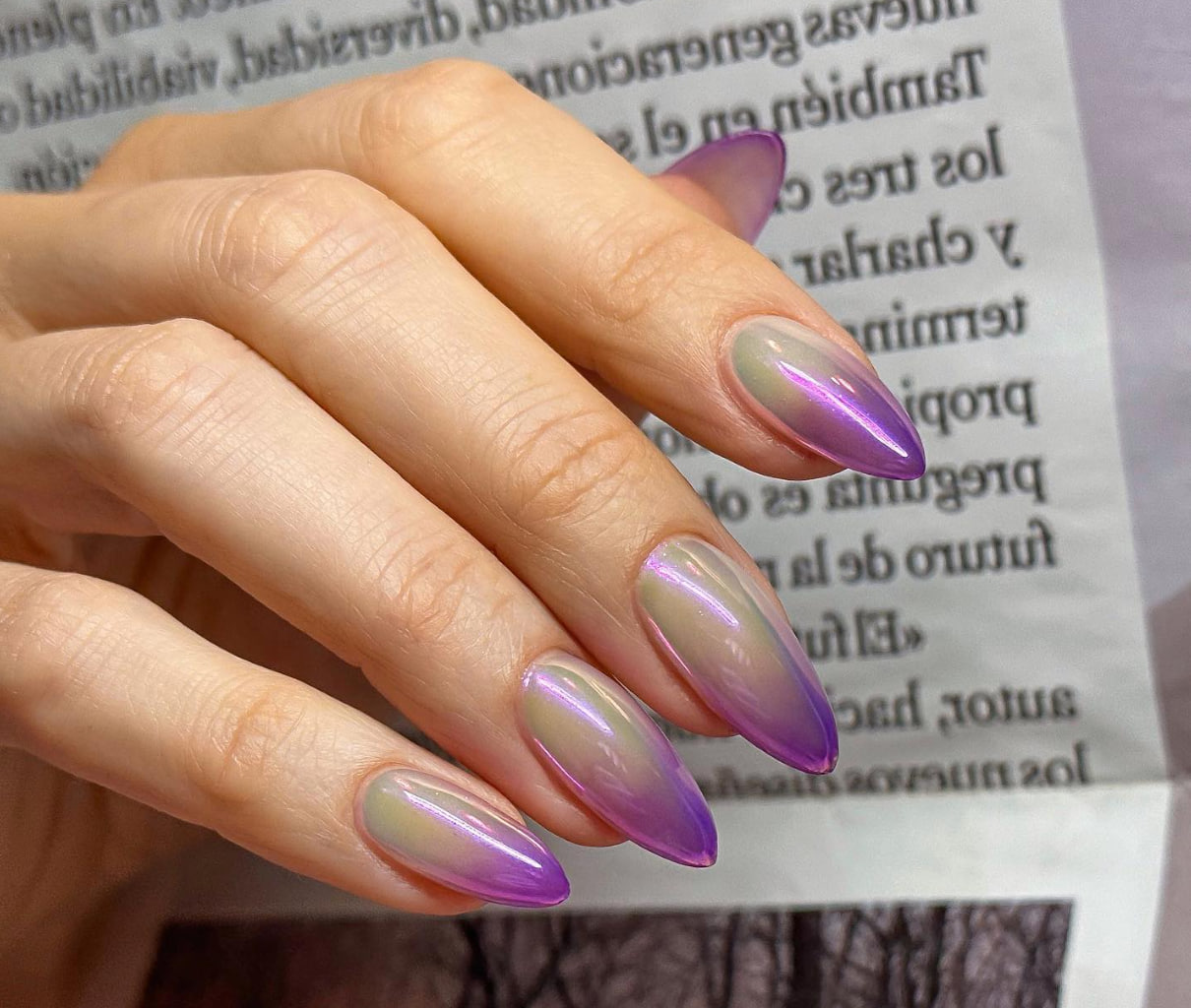
Pink and lilac: soft without looking bridal
If white ombré feels a little too classic, pink and lilac give you color without making the manicure difficult to wear.
A pale blush base can move into cool lavender near the tip.
Or reverse it.
Lilac at the base and pink toward the end feels slightly less expected.
For something stronger, use brighter versions of both colors rather than pastels. Fuchsia melting into purple keeps the same basic pairing but changes the personality completely.
Blue and turquoise: made for summer
A blue-to-turquoise nail gradient Chicago clients choose for warm weather has a very different energy.
It is clear and bright.
Think deep blue near the base becoming almost aqua toward the end, or a pale turquoise nail with a stronger blue aura in the middle.
A glossy topcoat makes these shades especially vivid.
Chrome over the gradient can push them further, though at that point the look becomes much more noticeable. If you want the colors themselves to remain the focus, leave the finish clean.
Black and burgundy: darker without going flat
Dark gradients are underrated.
A solid black manicure can sometimes feel severe, while burgundy alone is more traditional. Blend the two and you get depth without adding any actual illustration.
Burgundy can sit through most of the nail before darkening to black at the tip.
Or black can frame a wine-colored center.
In certain lighting, the transition looks subtle. Under brighter light, the red comes forward.
That makes it especially good for fall and winter.
Choose by season, but loosely
There is no rule saying pale colors belong to spring and dark shades belong to December.
Still, seasonal palettes can help when you have no idea where to start.
For spring, try combinations such as blush and lilac, pale blue and white, or peach fading into cream.
Summer can take more saturation. Hot pink and orange, turquoise and cobalt, coral and yellow.
Fall works well with terracotta and brown, burgundy and black, olive and smoky beige.
Winter gives you both extremes: black with wine red, navy with silver-gray, or a very pale milky gradient with pearl chrome over the top.
You do not need five colors.
Usually two good ones are more effective.
How long does airbrush ombré last?
The airbrush design itself does not have a completely separate wear time from the manicure underneath it.
It lasts with the base coating.
With hard gel, an airbrush ombré manicure can typically be worn for around 6–8 weeks, depending on nail growth, maintenance and when the set needs balancing or refreshing.
With gel polish, the usual wear period is around 2–3 weeks.
In other words, you do not need special maintenance simply because the color was applied with an airbrush.
Aftercare is basically the same as it would be with a regular manicure.
Avoid using your nails as tools. Wear gloves when cleaning with harsh household products. Keep cuticle oil around if you want the surrounding skin to stay comfortable and neat.
And pay attention to lifting.
Do not pick at a corner if the coating begins separating from the nail. That tends to turn one small problem into a much larger missing section surprisingly fast.
The gradient does not gradually "rub off" while the manicure underneath remains perfect. Once it is sealed, the design is part of the finished coating.
What usually changes first is simply the growth at the cuticle.
Especially after several weeks.
Airbrush ombré at Flamant: pricing and how to book
At Flamant, airbrush ombré is $30 extra with any manicure.
That means you choose the manicure service you need first, then add the ombré design rather than booking it as a completely separate manicure.
Allow roughly 30 additional minutes for the airbrush portion.
And bring references.
Seriously, bring them.
"Pink ombré" could mean barely-there blush fading into white, a neon pink-to-orange gradient, a darker pink aura on a nude base or about twenty other things. A reference photo gets everyone onto the same page immediately.
It does not mean the final result has to be copied exactly.
Your nail length may be different. Your shape may change how much room the gradient has. You might like the placement but want completely different colors.
That is fine.
Save two or three images if they show different parts of what you want. Maybe one has the color combination, another has the fade placement and a third shows the nail shape you like.
Flamant offers airbrush ombré at its Chicago and Wilmette locations, so clients can choose the location that works better for them.
If you already know your color combination, great.
If not, coming in with a general direction is enough. "Dark red but not too bright" is still more useful than trying to choose a precise polish shade before seeing it in person.
Sometimes the right combination becomes obvious once the colors are sitting next to each other.
Frequently Asked Questions
What is the difference between ombré nails and airbrush ombré nails?
Ombré describes the finished gradient effect, while airbrush refers to one technique used to create it. Airbrush equipment sprays very fine layers of color, allowing the technician to build a particularly smooth transition between shades.
How much do airbrush ombré nails cost at Flamant?
Airbrush ombré costs $30 extra with any manicure at Flamant. The gradient is added to the manicure service you select, and the airbrush portion generally adds around 30 minutes to the appointment.
Can you do white and pink airbrush ombré nails?
Yes. White fading into nude or pink is one of the most recognizable airbrush combinations and works especially well when you want a soft gradient rather than the defined white edge of a traditional French manicure.
Can airbrush ombré be done on short nails?
Yes. Short nails can wear ombré, though the transition may need to be more compact because there is less surface area. Simple two-color fades usually translate especially well to shorter shapes.
Should I bring a reference photo for gradient nails?
Preferably, yes. Gradient placement, color intensity and the point where the shades begin blending can vary considerably. A reference gives the technician a much clearer idea of the effect you have in mind.
Want gradient nails in Chicago or Wilmette? Book at Flamant and bring your color ideas.